
Sicily is an amazing place to visit and should be on the bucket list of any traveler.
Sicily is one of the twenty regions of Italy (one of five autonomous regions), and at 9,927 square miles in size, it is the largest island in the Mediterranean.
This is why we generally recommend multiple trips to Sicily so you can also take your time and really enjoy it.
The best way to visit Sicily is by splitting your visits into at least two trips…one to visit the western portion of the island, and the other to visit the eastern half.
First, let’s have a look at where you can actually find Sicily.

As you can see, you can find Sicily down by the toe of Italy’s boot. The Strait of Messina separates Sicily from the mainland.
While it is the most populated island in the Mediterranean, with about 4.8 million inhabitants, it is far from the most densely populated.
Sicily is quite mountainous, and the tops of most mountains are exposed rock, giving the landscape a rough and hard look.
Because Sicily is located on the northern edge of the African Plate, the main island and a few of the surrounding small islands have some highly active volcanoes.
The most famous of these is Mt. Etna, located at the east side of Sicily to the north of the city of Catania. Mt. Etna is the most active volcano in Europe, and it stands nearly 11,000 feet high.
To the north of Sicily are the three volcanic islands of Stromboli, Vulcano and Lipari. The volcanoes on Stromboli and Vulcano are still active, while Lipari has been dormant for about 1,500 years.
Sicily is bordered to the north by the Tyrrhenian Sea, the south and west by the greater Mediterranean and the east by the Ionian Sea.
At present, you can get to Sicily from the mainland by car or rail with a ferry. Italy has also been planning a bridge to connect Sicily to the mainland for years, but we don’t expect that to be completed any time soon, if they can even get it started!
Sicily has two main cities… Palermo in the west and Catania in the east. Both have airports, so you should choose which airport to fly into based upon which side of the island you intend to visit.
Sicily Climate
The climate in Sicily is mild in the Winter and hot and dry in the Summer.
At its coolest in February, according to Weatherspark, the average high is 58 degrees and the average low is 50 degrees. This makes the climate in Sicily far more mild than in most places in mainland Italy.
During the peak heat of the Summer, which occurs in early August, the average high is 85 and the average low is 75.
In 2023, Sicily experienced higher than average temperatures in the summer, reaching over 115 degrees. Because the climate is quite dry in the summer, this led to a number of devastating wildfires.
Sicily is known as a popular beach destination in the summer months. At one of the most popular beach towns, Cefalu on the north coast, the average water temperature can exceed 80 degrees.
The water temperature in many years is still warm enough for swimming into the middle of October and even later.
As a result, mid-September to mid-October can be the most pleasant time to head to the beaches in Sicily, as they will be somewhat less crowded, particularly on weekdays.
In general, Spring and Fall are the most pleasant times to visit Sicily.
Whether you fly into Palermo or Catania, you should consider spending a couple days exploring each.
A brief history of Sicily
Sicily’s history is what makes it so cool to visit.

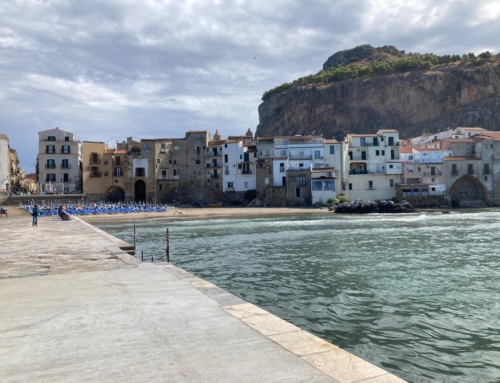
The promenade and beach in Cefalu
Before I get into this little bit of history of the island, let me tell you about a quick experience I had there, and one you can have as well.
In Cefalu, as you are standing in the water looking back at the town, you see the giant rock that towers over the town. It is literally called “The Rock.”
On top of the rock sits the remains of an ancient Greek temple. Then, down below the rock, sitting at the highest part of Cefalu, stands the Norman cathedral, built around 1200.
Where else in the world can you get such a view?
Because of its location in the Mediterranean Sea and proximity to both Africa and Europe, Sicily is one of the most conquered lands in all of the world.
As a result, the Sicilian culture is influenced by Greek, Roman, Arab and even the Normans of northwest Europe.
The first evidence of human colonization of Sicily appears about 16,000 years ago.
During the classical ancient period, there were three primary groups of people inhabiting the island; the Sicani, Elymians and the Sicels.
It is believed that the Sicani arrived from the area now known as Spain, the Elymians from the Aegean region (Greece) and the Sicels from mainland Italy.
The Phoenicians began to arrive some time around 1000 BC, followed by the Greeks a few hundred years later. The most important Greek colony was in Syracuse at the southeast corner of the island.

Greek Theater in Taormina
The Greeks then colonized much of the island and built a number of temples in Sicily. The most famous of these are located in the Valley of the Temples near Agrigento in western Sicily.
Syracuse became highly desired among the Greek city-states, sparking the attempted Athenian invasion during the Pelopponesian War in 415 BC. Athens was pitted against Sparta and Corinth, who ultimately defeated the Athenians.
Sparta became the dominant power in the world of ancient Greece as a result of this victory.
During this time, the Greeks controlled the eastern part of Sicily, while the Carthaginians of North Africa controlled the west.
At some point in the 3rd century BC, the Greeks aligned with Rome. Two wars were then fought between Rome and Carthage ending with the Romans controlling Sicily by 210 BC.
Sicily remained a Roman province for the next 700 years.
Christianity first arrived to the island around 200 AD and spread rapidly after Emperor Constantine the Great lifted the ban on Christianity throughout the empire.
For a brief period after the fall of Rome, Germanic tribes ruled Sicily. This was followed by Byzantine rule beginning in the 5th century and lasting until 965.
By then, all of Sicily was under Arab rule, which lasted until the Normans conquered the island in the late 11th century.
Norman rule lasted about a century when Sicily became the Kingdom of Sicily, which lasted until 1860 when Guiseppe Garibaldi captured the island. Eventually, Sicily became part of the Italian Kingdom as part of the unification of Italy in 1861.
Italy became a republic in 1946 after its defeat in World War II. As part of the Italian Constitution, Sicily was one of five regions given special status as an autonomous region.
Beginning in the early 20th century, Sicily came under the heavy influence of the Sicilian mafia.
In spite of major efforts by the Italian government, this influence remains due to mafia ties to some local governments, particularly around the capital of Palermo.
However, this influence has waned.
Notably, Sicily has been less developed than most of the Italian mainland, but major investments by the Italian government have helped the Sicilian economy over time.
As a result, the island continues to become more modernized, which is helping it become more popular among tourists and, to a small degree, expats.
Transportation to and in Sicily
There are two main airports on Sicily. The Palermo airport is actually about 35-40 minutes away by car, and is located on the west coast. The other major airport is located in Catania along the east coast. You’ll want to fly to the airport closest to where you are staying initially.
Direct flights from the U.S. to Sicily are generally only available from airports near New York City.
The best way to get around Sicily is by car. However, driving through the cities and small towns themselves is extremely tricky. Therefore, if you do intend to rent a car, you will want to be sure your accommodations have parking on site, and are close to public transportation, or close to primary sites you want to see.
You’ll need an international driver permit along with your driver’s license. If you do not have an international driver’s permit, head on over to your nearest AAA office.
For finding the best deals on rental cars, check out Discover Cars.
Another way to get around Sicily is by train. However, train service tends to be most available along the north and east coasts.
There are no high-speed trains on Sicily, but there are intercity trains running between a few of the major cities that will get you to your destination a little more quickly.
Typically, if you are travelling a significant distance, you will end up with a mix of intercity and regional trains.
While the intercity trains offer assigned seats, this is not the case with the regional trains. As a result, getting on a regional train can be a bit chaotic, and somewhat difficult with luggage, particularly at rush hour.
Places to visit on the west side of Sicily

Palermo Opera House
Palermo’s airport is located about 30 minutes to the west of the city. You can catch a train from the airport to Palermo Centrale station and then get a quick ride to your accommodation.
In Palermo, you’ll want to stay near the historical center of the city for a couple days before you venture out.
We recommend B&B Sant’Agostino. It’s close to Via Maqueda, which is where you will find great places to eat along with the Teatro Massimo di Palermo and Quattro Canti.
While in Palermo, you will want to explore the aforementioned Via Maqueda, the waterfront area, Giardino Garibaldi, Palazzo Reale, Cattedrale di Palermo, Palazzo della Zisa and the Chiesa di Santa Maria dell’Ammiraglio, among other sites.
Be sure to check out a couple of the outdoor markets as well.
While still in Palermo, take a day trip to Agrigento to visit the Valley of the Temples.
You can get to the town by train and then grab a transport over to the temple site. The train ride is about two hours, so you will want to get started early.

Castellamare del Golfo
If you have time, head over to Scala dei Turchi beach, where you will find whitewashed cliffs along the beach and a spectacular view.
If you are visiting Palermo during the warm months, then be sure to spend a few hours at Mondello Beach, which is about five miles away from the historic center.
Once you are done exploring Palermo and Agrigento you will want to rent a car and explore some of the sites to the west for a couple days.
These include Castellemare del Golfo, Scopello, San Vito Lo Capo and Trapani.
From Palermo, you can reach the first two towns easily and make a nice day trip out of it. If you decide to head to San Vito Lo Capo and/or Trapani, you will want to stay at one of those towns.
We recommend San Vito Lo Capo due to its spectacular beach.
The last stop you will want to make in western Sicily is Cefalu. You can get to Cefalu by train from Palermo in under an hour.
The primary spots to visit in Cefalu are the main square, where you will find the 12th century Norman Cathedral, which then backs up to La Rocca Cefalu, i.e., The Rock.
If you hike to the top of La Rocca, you will find the remains of an ancient Greek temple and spectacular views of the Tyrrhenian Sea.
Explore the alleys of the historic town, and then find yourself at the pier where you can get a great view of the coastline.
From there, work your way to Via Vittorio Emanuele and follow it to the promenade along the beach.
We highly recommend staying at the Artemis Hotel. It is very close to the train station and within walking distance to the beach and the historic center.
Where to go in Eastern Sicily
As indicated, we recommend splitting up a trip to Sicily by east and west. To get to the east side of the island, you’ll want to fly into Catania.
Catania is the second largest city on Sicily by population, after Palermo. Catania has a rich history and is home to Sicily’s oldest university.
Because it is located closer to the mainland, Catania is actually the commercial and logistical hub of the island and its airport is the largest in southern Italy.
Catania boasts a mix of ancient Greek and Roman ruins, a number of historical churches noted for their Baroque architecture, medieval castles and a variety of palaces.
After your stay in Catania, head north to the historic port city of Messina.
Messina is the closest city to mainland Italy and is a major cruise port. However, it is often overlooked by travelers to Sicily due to all of the other attractions on the island.
With that said, there are a number of attractions you may want to check out in Messina, such as the Norman Cathedral, Chiesa del Carmine, Church of Santa Maria degli Alemanni, Palazzo Calapaj-d’Alcontresj, the Botanical Garden Pietro Castelli, and the regional museum of Messina, among others.
The train ride from Catania to Messina typically takes about 90 minutes.

Piazza Aprile Taormina
From Messina, head south to Taormina.
Perched high above the Tyrrhenian Sea, this small town is one of the most beautiful you will ever visit.
The primary feature of the town is the ancient Greek Theater perched on a hill above town.
Here you will get a glimpse of ancient history and amazing views. On a clear day, you will also be able to see Mt. Etna.
Speaking of Mt. Etna, you can take a day trip there from Taormina and take a hike up the mountain. There are also several wineries you can visit there as well.
Once you have visited the Greek theater, you will just want to take your time and stroll through town.
The main shopping street is Corso Umberto, and you will want to stroll along there over to Piazza IX Aprile, where once again you will find spectacular views.
We also recommend checking out the beaches below town. The more famous of the two is Isola Bella, but I would argue that the beach just to the north is almost as nice.
You can get down to these beaches via a cable car ride.
If you have time, take a few hours to visit the small town perched above Taormina, Castelmola.
We didn’t have time to get there on our visit, but it was highly recommended by our host at Casa Arico, a very cool little, family-owned B&B with an amazing rooftop deck.
The train ride from Messina to Taormina takes about 35 minutes. You’ll need to then take a taxi from the train station up to town.
After Taormina, head south to Syracuse. Again, you can take a train and the ride is about two hours.

Ancient Greek Theater Syracuse
Syracuse is one of the most important historical sites in Sicily, as it is the site of several significant ancient battles involving the Greeks, Romans and Carthaginians over the course of a couple hundred years.
Another major naval battle occurred there in the early 18th century between the French and English navies.
For centuries, Syracuse was actually the capital city of Sicily, until the Muslim invasion in the late 9th century.
As a result of the historical significance of the city and its location, it is home to a mix of ancient ruins, medieval and Renaissance period architecture and Baroque architecture.
The historic center of Syracuse is located on the island of Ortigia, which is connected to the rest of Syracuse by two bridges.
Ortigia is where Syracuse was founded by the ancient Greeks.
Some of the main attractions in Syracuse include the ancient Greek theater, Grotta del Ninfeo, the Roman amphitheater, the Syracusan Forum, Palazzo Dell’Orologio, Piazza Archimedes, the Temple of Athena, and Cathedral of the Nativity of the Blessed Virgin Mary, among others.
The area around Syracuse also has some spectacular beaches if you need another beach day while in Sicily.
While you stay in Syracuse, consider a day trip to include Noto just to the south and Ragusa to the southwest. Both are within a 90 minute drive (Noto is closest).
Both are worth a visit to see more of Sicily’s amazing architecture.
Final Thoughts on travel to Sicily
By now you can probably see that there many places to visit in Sicily, and the cities and towns mentioned here are not an all-inclusive list.
If you intend to only visit Sicily once, you are probably selling yourself short, unless you plan on staying at least a month.
Sicily is not just about seeing its many wonders… just like the rest of Italy, Sicily is also about enjoying the culture.
That is why we recommend at least two visits to this wonderful part of Italy, and you’ll probably want to spend ten days to two weeks on both trips.
Now go!
Discover more from Your Journey To Italy
Subscribe to get the latest posts sent to your email.